Label-less water bottles and digital labels in Thailand under Notification No. 462
Since 12 December 2025, bottled water in Thailand may come in label-less bottles, provided the basic details are on the bottle or cap and a digital label, such as a QR code, is on the cap. The rules, the penalty and a checklist for buyers.
- Published
- Updated
- Reading time
- 20 min
- Contents
- 17 sections
- Sources
- 13
A label-less water bottle is a drinking-water bottle with no wrap-around or stick-on label and no ink printed on the bottle itself. The basic product details are moulded into the bottle or printed on the cap, and the rest of the label information is reached through a digital label, such as a QR code on the cap. In Thailand, bottles like this have had an explicit legal basis since 12 December 2025, under Notification of the Ministry of Public Health (No. 462) B.E. 2568 (2025) Re: Drinking Water in Sealed Containers.
The parts of the notification that concern label-less bottles come down to five points.
- Label-less bottles have had an explicit legal basis in Thailand since 12 December 2025.
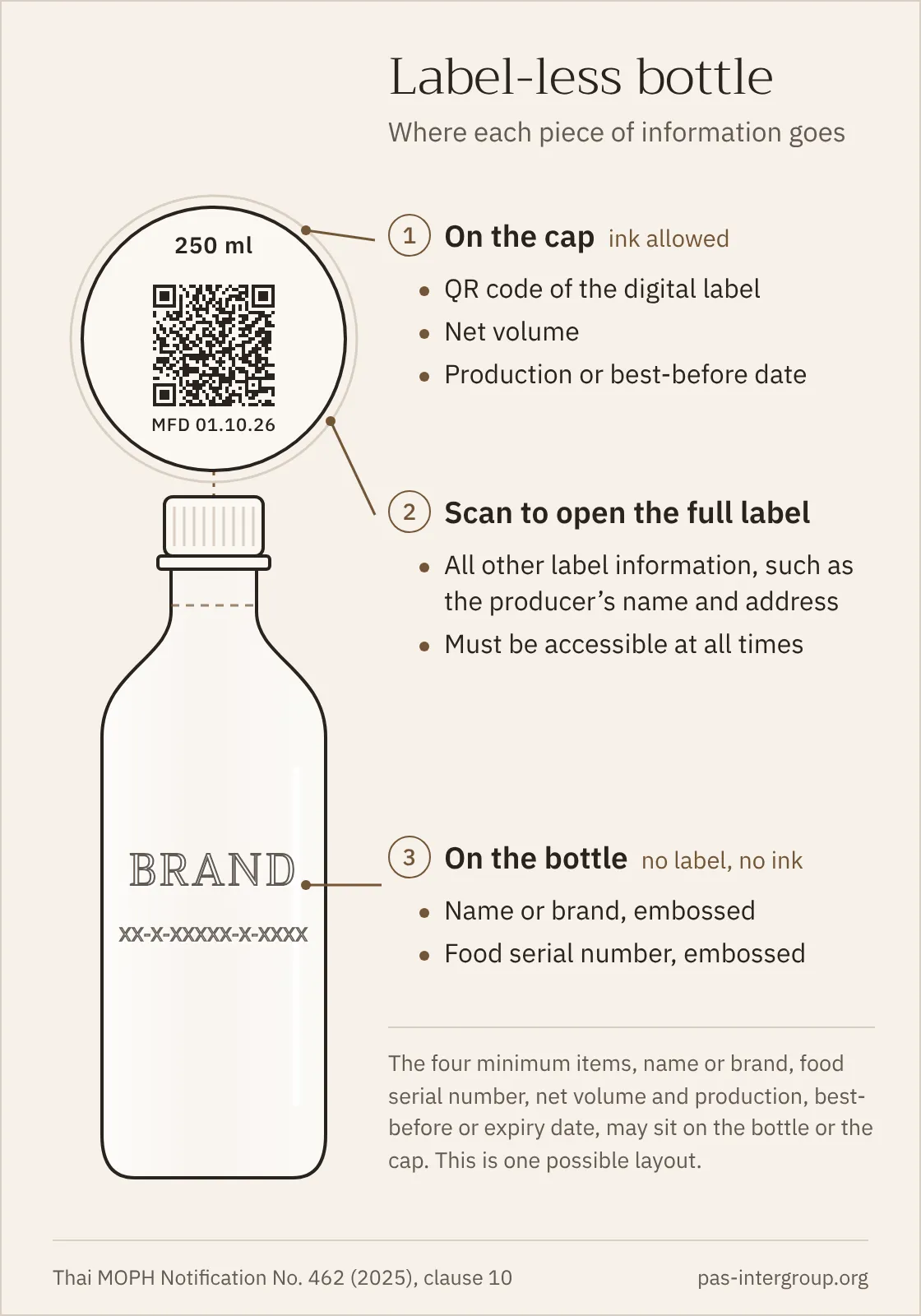
- The bottle or cap must carry at least four items: the food name or brand, the food serial number, the net volume, and a production, best-before or expiry date.
- All other label information must be in a digital label on the cap, and it must be accessible at all times.
- A label-less bottle without a digital label, such as a QR code, on the cap does not meet the notification, and the Food Act B.E. 2522 (1979) sets a fine of up to 30,000 baht for breaching labelling notifications.
- Going label-less is optional. A bottle labelled in full under the general rules is still acceptable.
In this article17 sections
- What is a label-less water bottle?
- What is a digital label?
- Are label-less water bottles legal in Thailand?
- What must a label-less bottle show on the bottle itself?
- Does the QR code have to be on the cap?
- What must the digital label contain?
- Does the digital label have to be available at all times?
- Is a label-less bottle without a QR code on the cap illegal in Thailand?
- By when must Thai bottled water producers comply with Notification No. 462?
- How do label-less bottles help recycling?
- Can natural mineral water and soda water use digital labels?
- Which other countries use label-less bottled water?
- Timeline of label-less bottled water
- Which organisations in Thailand already use label-less bottles with digital labels?
- Checklist before ordering label-less corporate water
- Clause 10 of Notification No. 462: unofficial translation
- How can an organisation order label-less bottled water under its own brand?
- Sources
What is a label-less water bottle?
A label-less water bottle is a drinking-water bottle that carries no label and no printing ink on the bottle itself. Notification No. 462 describes this as showing the label or symbol without label material and without printing ink on the container, except on the cap. The basic details are therefore formed in the bottle, for example by embossing or engraving, or printed on the cap, and the remaining label information is provided through a digital label on the cap.
The same idea is also called a label-free or no-label bottle, and in Thai ขวดไร้ฉลาก or น้ำดื่มไร้ฉลาก. Label-less means without label material, not without information: everything the law requires must still be shown, only it moves to the bottle surface, the cap and the digital label.
What is a digital label?
A digital label is food label information published in a digital form that a consumer opens on a mobile phone. For bottled drinking water, the Thai Food and Drug Administration (Thai FDA) gives a QR code on the cap as the example: scanning it opens the full label page for the product. Under Notification No. 462, that page must carry the complete label information required by Thai food labelling rules and must be accessible at all times.
The notification itself uses the term digital label and does not say that it must be a QR code. The Thai FDA nevertheless gives a QR code on the cap as its example in both of its press releases on the subject, dated 9 January 2025 and 6 July 2025, so this article uses QR code to mean the common form of digital label.
Are label-less water bottles legal in Thailand?
Yes. Notification of the Ministry of Public Health (No. 462) B.E. 2568 (2025) Re: Drinking Water in Sealed Containers was published in the Royal Gazette on 11 December 2025 and took effect on 12 December 2025. It allows bottled drinking water to show its label without label material and without printing ink on the container, except on the cap, provided the minimum details are shown on the container and the rest is provided through a digital label on the cap.
The notification appears in the Royal Gazette, Volume 142, Special Part 386 Ngor, pages 15 to 18. It is dated 28 November 2025, was issued by the Minister of Public Health, and replaces five earlier notifications on the same subject, the first of them from 1981. The Thai FDA described the change as adding rules that let clear, plastic-label-free water bottles show their information through a digital label.
What must a label-less bottle show on the bottle itself?
At least four items must appear on the container: the food name, or the brand, trademark or registered trademark; the food serial number; the net volume; and the day, month and year, or month and year, of production, best-before or expiry, marked MFD or MFG, BB or BF or BBE, or EXP or EXD respectively. This is set out in clause 10 (1) of Notification No. 462, which also states that text shown this way need not be in a contrasting colour.
The food serial number is the product registration number known in Thailand as the อย. (Or Yor) number. The four items can sit on the bottle, on the cap or be split between them: the notification says on the container, and a Thai FDA Food Division summary of the draft notification, dated 18 August 2025, gives their place as the container (bottle or cap). On the AP water that P.A.S. Intergroup produces, the logo is embossed on the bottle and the QR code is printed in the centre of the cap, with the net volume above it.
Details that change with every production run, such as the production, best-before or expiry date, are excepted from the digital label and must be shown on the container, so a consumer reads the date from the bottle itself without scanning anything.
Does the QR code have to be on the cap?
Yes, for a label-less bottle. Clause 10 (2) of Notification No. 462 requires a bottle without label material and without printing ink on the container to provide the remaining label information through a digital label on the cap. A QR code, the form of digital label the Thai FDA gives as its example, therefore goes on the cap, not on the bottle, and the cap is the part of the container the notification exempts, so it may carry ink.
This matches what the Thai FDA said while the rule was in draft. Both of its 2025 press releases use the same wording: other information is to be shown through a digital label, such as a QR code on the cap.
What must the digital label contain?
The digital label must carry the complete label information required by the Ministry of Public Health notification on labelling of prepackaged food, together with the statements specific to each type of water, such as the characteristics of the source for source-identified water, or the words added carbonate for water carbonated from another source. The one exception is the production, best-before and expiry date, which must be shown on the container instead. This is clause 10 (2) of Notification No. 462.
The labelling notification currently in force is Notification of the Ministry of Public Health (No. 450) B.E. 2567 (2024). The table below shows where each item belongs. The digital-label rows follow the examples in the Thai FDA Food Division summary and are not a complete list of every requirement in Notification No. 450.
| Information | On the bottle or cap | In the digital label on the cap |
|---|---|---|
| Food name, or brand or trademark | Required | Required |
| Food serial number | Required | Required |
| Net volume | Required | Required |
| Production, best-before or expiry date | Required, marked MFD, BB or EXP, for example | Not required |
| Name and address of the manufacturer or importer | Optional | Required |
| Food additives used, if any | Optional | Required |
| Statements specific to the type of water, such as the source and its location, or added carbonate | Optional | Required where applicable |
| Any other information required by the labelling notification | Optional | Required in full |
Does the digital label have to be available at all times?
Yes. Clause 10 (3) of Notification No. 462 requires food information shown through a digital label to be accessible at all times, with the system controlled so that it keeps working without interruption. If the QR code will not scan, the link breaks or the website hosting the page goes offline, the consumer cannot see the label information the notification requires.
For an organisation ordering water under its own brand, this raises questions to put to the producer before ordering: who maintains the digital label page, how long it will stay online, and who updates it if the label information changes. A bottle stays in circulation until its best-before date, so although the notification sets no end date, in practice the page should stay available at least for as long as the last batch is on the market and in consumers’ hands.
Is a label-less bottle without a QR code on the cap illegal in Thailand?
Yes, if the bottle carries neither label material nor printing ink on the bottle and has no digital label, such as a QR code, on the cap. Clause 10 (2) of Notification No. 462 requires such a bottle to provide the remaining label information through a digital label on the cap, so a bottle that only has an embossed name or logo does not show its label as the notification requires. Section 51 of the Food Act B.E. 2522 (1979) provides that whoever violates a notification issued under section 6 (10), the labelling power, is liable to a fine of up to 30,000 baht.
The provision is applied in practice. In August 2024, for example, the Thai newspaper Matichon reported that selling imported food without Thai-language labels fell under section 6 (10) and was punishable under section 51 by a fine of up to 30,000 baht.
Two cases need to be kept apart.
-
A bottle labelled, or printed, with complete label information on the bottle This bottle follows the general labelling rules rather than the label-less route, so it does not need a QR code on the cap.
-
A bottle with no label and no printing ink on the bottle This bottle must carry the four minimum items on the bottle or cap and must always have a digital label on the cap. If either is missing, its labelling does not meet the notification.
The question is therefore not simply whether there is a QR code, but whether the label information is complete and shown where the notification requires.
The notification does not name who carries the duty, and section 51 applies to whoever violates it. In practice the producer or importer holding the food serial number is directly responsible for the label, but sellers can also face action, as in the Matichon case. With corporate-branded water, a bottle that falls short also goes out under the name and logo of the organisation that ordered it, so it is worth asking for sample bottles and scanning the QR code on the cap yourself, using the checklist at the end of this article.
By when must Thai bottled water producers comply with Notification No. 462?
Within two years of 12 December 2025, under clause 12 of Notification No. 462. The period applies to producers and importers of drinking water licensed before that date under Notification No. 61 (1981) as amended, to producers and importers of water containing carbon dioxide or oxygen licensed under Notification No. 356 (2013) on beverages in sealed containers, and to food producers who use water as an ingredient or in processing. Licences granted from 12 December 2025 must comply straight away.
The two-year period covers the whole notification, which deals with water quality, contaminants and containers as well as labelling, so every existing licensee must meet all of it by December 2027, whatever bottle it uses.
Going label-less is a choice. The Thai FDA press release of 6 July 2025, describing the draft, called the digital label voluntary: a producer may keep labelled bottles or switch to label-less ones, but a label-less bottle must have a digital label on the cap.
How do label-less bottles help recycling?
A label-less bottle removes label material, adhesive and printing ink from the bottle. The Thai FDA says the change is intended to reduce waste from label materials, make plastic recycling less complicated, lower the cost of recycled plastic resin and of recycling, and reduce the chance of ink and adhesive contaminating recycled resin.
The RecyClass design-for-recycling guidelines for clear PET bottles, updated in January 2025, class direct printing on the bottle as not compatible with recycling, except production or expiry dates, which have limited compatibility when printed and are fully compatible when laser-marked. They also cap the share of the surface that may be covered by non-PET material. A bottle with no label leaves only PET and the cap, which is consistent with the Thai FDA’s reasoning.
As for how much plastic is saved, South Korea, where label-less bottled water became compulsory in 2026, estimated a reduction of about 2,270 tonnes of plastic a year, based on roughly 5.2 billion bottles produced the year before.
Labels and caps have to be separated before a bottle can be recycled. The process is described in how PET bottles are recycled and in common questions about PET bottles and recycling.
Can natural mineral water and soda water use digital labels?
Yes. Water containing carbon dioxide falls within the definition of drinking water in sealed containers in Notification No. 462, so the same digital label rules apply. Natural mineral water is excluded from Notification No. 462, but Notification of the Ministry of Public Health (No. 464) B.E. 2568 (2025) Re: Natural Mineral Water (No. 2), which took effect on the same day, also permits a digital label on the cap for containers labelled without label material or printing ink, except, according to the Thai FDA Food Division summary, natural mineral water that must carry a fluoride warning.
Notification No. 462 also covers source-identified water, which must carry additional statements such as the characteristics of the source and its geographical location. These statements can be placed in the digital label like any other information.
Which other countries use label-less bottled water?
Several, and at least one makes it compulsory. South Korea has required bottled water to be label-less since 1 January 2026: the product name, brand, production and expiry dates, water source and contact details are printed on the bottle or cap, and a QR code on the cap gives the full details. In Japan, Asahi began selling its Asahi Oishii Mizu mineral water in label-less PET bottles in 2018, at first by the case only.
South Korea gave single bottles sold in physical shops an extra year, because of concerns that some small retailers might not yet have checkout equipment that reads QR codes; online and multipack sales had to comply straight away. Asahi reports that its distribution volume of label-free products in 2023 was eight times that of 2019.
Timeline of label-less bottled water
| Date | Event |
|---|---|
| 2018 | Japan: Asahi begins selling mineral water in label-less PET bottles, by the case |
| 2023 | Thailand: media report the launch of C2 drinking water, billed as the first clear label-less bottle in Thailand, with an embossed design instead of a label and a barcode on the cap |
| 9 January 2025 | The Thai FDA announces a draft notification for label-less drinking water with digital labels |
| 6 July 2025 | The Thai FDA reports that the draft has gone to the Food Committee, to be proposed to the Minister of Public Health |
| 28 November 2025 | Notification No. 462 is dated and issued by the Minister of Public Health |
| 11 December 2025 | Notification No. 462 is published in the Royal Gazette |
| 12 December 2025 | Notifications No. 462 and No. 464 take effect |
| 1 January 2026 | South Korea makes label-less bottled water compulsory |
| 2026 | AP (Thailand) adopts label-less corporate water with a digital label on the cap, produced by P.A.S. Intergroup |
| December 2027 | The two-year compliance period for existing licensees under Notification No. 462 ends |
Which organisations in Thailand already use label-less bottles with digital labels?
AP (Thailand) is among the first organisations in Thailand to move its corporate-branded drinking water to label-less bottles with a digital label on the cap since Notification No. 462 took effect. The 250 ml AP bottle has the AP logo embossed on the bottle, with the QR code of the digital label printed in the centre of the cap and the net volume above it, and it is produced by P.A.S. Intergroup.
Checklist before ordering label-less corporate water
Use this list to check sample bottles before approving production, whichever producer you order from.
-
The four items are on the bottle or cap Food name or brand, food serial number, net volume, and production, best-before or expiry date, marked MFD, BB or EXP, for example.
-
The QR code is on the cap and scans Scan real sample bottles with several phone models in ordinary light, not the artwork file on a computer screen.
-
The digital label page is complete It must be complete under the labelling notification, including the food name or brand, food serial number, net volume, the name and address of the manufacturer or importer, food additives used, if any, and any statements required for the type of water. The serial number on the page must match the one on the bottle.
-
The food serial number can be verified Check the serial number against the Thai FDA product search to confirm it matches the producer and the product type.
-
You know who maintains the digital label page, and for how long Clause 10 (3) requires the digital label to be accessible at all times and sets no end date, so someone must be clearly responsible for the system, in practice at least for as long as the last batch is on the market.
-
The label page makes no exaggerated claims Clause 11 prohibits label or advertising statements suggesting the water can treat, relieve, cure or prevent disease, and statements that mislead about how natural the water is, its source, its composition or its properties.
-
The producer has recognised production standards Clause 8 requires drinking water producers to follow the notification on production methods, equipment and food storage. Ask to see the plant’s certificates.
Clause 10 of Notification No. 462: unofficial translation
The following is an unofficial English translation of clause 10 (2) and (3), from the Thai text in the Royal Gazette, Volume 142, Special Part 386 Ngor, page 17. The Thai FDA also publishes an English version on its Food Division website, listed in the sources below; only the Thai text in the Royal Gazette is legally binding.
(2) A label or symbol shown without label material and without printing ink on the container, except on the cap of the container, must show the information required by the Ministry of Public Health notification on labelling of prepackaged food in full, together with the statements under (4) and (5) as applicable, by means of a digital label on the cap, except for the day, month and year, or the month and year, of production, of best-before or of expiry.
(3) Food information shown by means of a digital label under (2) must be accessible at all times, and the system must be controlled so that it operates continuously.
Clause 10 (1) also contains a paragraph stating that item (ง), the date, applies to labelling that uses printing ink or label material under the labelling notification. It bears on how the date may be shown, so producers should check its interpretation against the Thai FDA’s clarifications before settling how a label-less bottle shows its date.
Clause 10 (4) and (5), referred to in (2), are the statements that must or may be shown depending on the type of water, such as the characteristics of the source, added carbonate, or no carbon dioxide. This article summarises the notification for general information and is not legal advice; for any specific product, check the full text and the Thai FDA’s clarifications.
How can an organisation order label-less bottled water under its own brand?
An organisation can order it from a drinking water plant that can produce bottles embossed with its brand and print caps in line with Notification No. 462. P.A.S. Intergroup produces label-less corporate-branded water at its own plant in Sam Phran, Nakhon Pathom: it designs bottles embossed with the client brand, blows them from preforms, purifies the water by reverse osmosis (R.O.), prints the QR code of the digital label and the net volume on the cap, and sets up and maintains the digital label page the QR code opens, under GHPs and HACCP, certified by Bureau Veritas.
Beyond the label information the notification requires, clients can add images or PDF files introducing the organisation to the digital label page, as on the digital label page of AP’s drinking water. Anything added should stay within clause 11 of the notification: no suggestion that the water treats or prevents disease, and nothing misleading about its source, composition or properties.
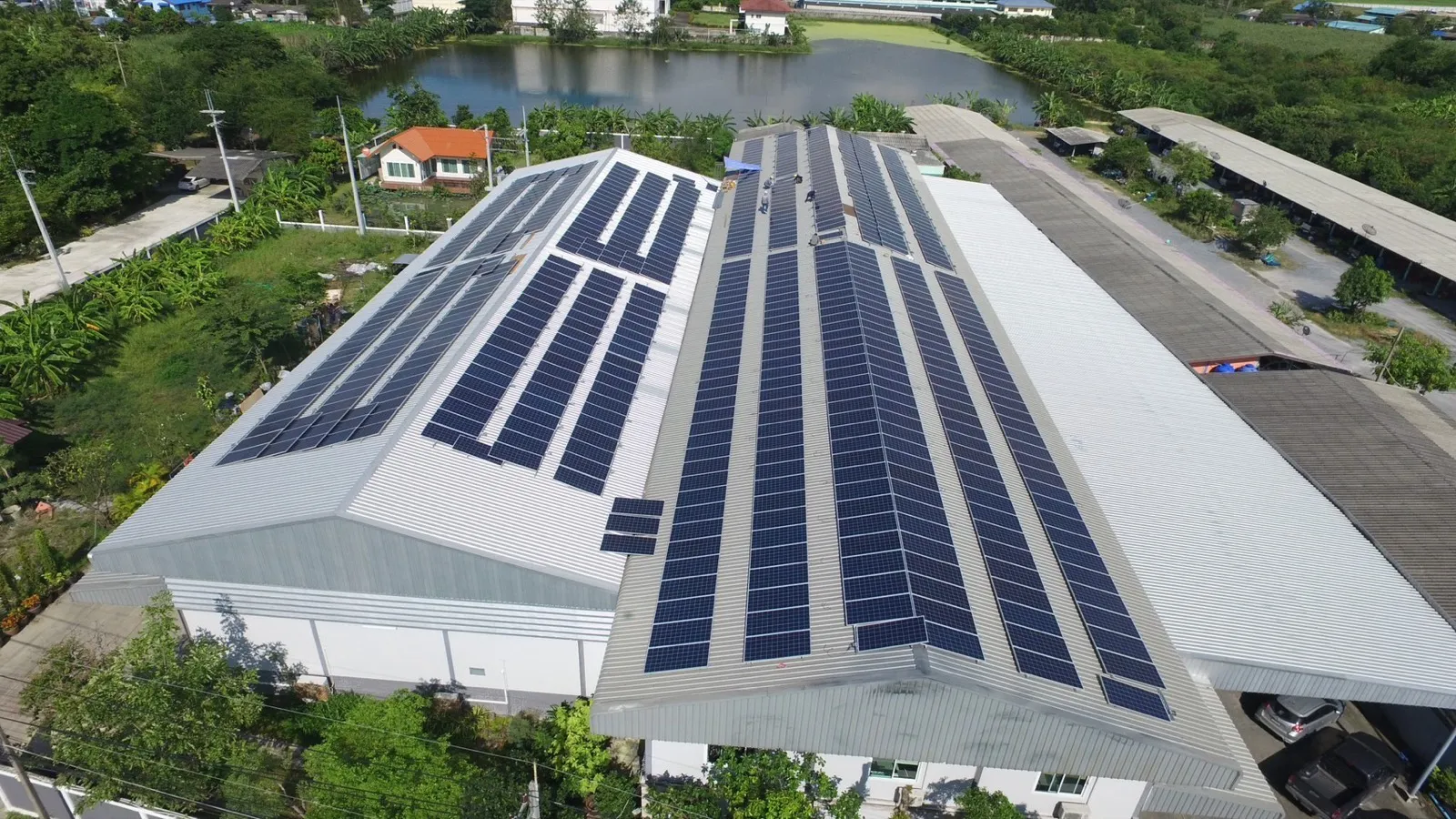
The plant has a rooftop solar system with an installed capacity of 370 kilowatts, and offers rPET bottles, made with resin from ENVICCO, as an option for clients who want to use less virgin material. How rPET differs from virgin PET is explained in what rPET is and how it differs from virgin PET.
Organisations that want to move their own-brand water to label-less bottles can contact P.A.S. Intergroup for advice and sample bottles.
Sources
- Ministry of Public Health, Thailand. (2025, 11 December). Notification of the Ministry of Public Health (No. 462) B.E. 2568 (2025) Re: Drinking Water in Sealed Containers. Royal Gazette, Volume 142, Special Part 386 Ngor, pages 15 to 18. In Thai.
- Food Division, Thai Food and Drug Administration. (n.d.). Drinking water in sealed containers: Notification No. 462 in Thai and English, clarification, guidelines and questions and answers.
- Thai Food and Drug Administration. (2025, 9 January). อย. ยกร่างประกาศฯ น้ำดื่มไร้ฉลาก ผู้บริโภคปลอดภัย ตอบโจทย์โลกยั่งยืน (Thai FDA drafts notification on label-less drinking water). Press release 79, fiscal year 2025. In Thai.
- Thai Food and Drug Administration. (2025, 6 July). อย. หนุนฉลากดิจิทัล ส่งผลดีทั้งผู้ผลิต ผู้บริโภค และสิ่งแวดล้อม (Thai FDA backs digital labels). Press release 182, fiscal year 2025. In Thai.
- Food Division, Thai Food and Drug Administration. (2025, 18 August). Summary of labelling provisions in the draft notifications on drinking water in sealed containers and on natural mineral water (No. 2). In Thai.
- Food Division, Thai Food and Drug Administration. (n.d.). Food law: food labelling and nutrition labelling.
- Food Act, B.E. 2522 (1979), sections 6 (10) and 51. English translation on FAOLEX: Food Act, B.E. 2522 (1979).
- Matichon Online. (2024, 1 August). เปิดชื่อ 11 “ซุปเปอร์มาเก็ตจีน” ในไทยขายของผิดกฎหมาย (Eleven Chinese supermarkets in Thailand found selling illegal goods). In Thai.
- ChemLinked. (2025). Ministry of Public Health Notification (No. 464) B.E. 2568 (2025) Re: Natural Mineral Water (No. 2).
- RecyClass. (2025, January). Design for Recycling Guidelines: Clear PET bottles.
- Korea JoongAng Daily. (2025, 10 December). Bottled water sold in Korea to go label-free from next year.
- Asahi Group Holdings. (2024, 1 April). Pioneering Label-Free Packaging for a Sustainable Future.
- Krungthep Turakij. (2023, 1 May). ‘ซีทรู’ หน้าใหม่ ใจใหญ่ ชิงน้ำดื่ม 7 หมื่นล. (C2 enters the drinking water market). In Thai.